Separate the contexts
Review projects, appearances and controversies as distinct conversations.
Blura SAGA for Celebrities
Blura SAGA is a social media intelligence platform for celebrities, public figures, talent managers and PR teams. Understand audience sentiment around projects and appearances, identify emerging reputation risks and discover the communities, conversations and events shaping public perception.

Reputation in context
Reactions to a film, appearance, endorsement or public statement can move in very different directions. Blura SAGA separates these conversations by context and connects changes to the discussion behind them, helping teams understand what is driving attention and where reputation is shifting.
How Blura SAGA analyses sentiment and narrativesReview projects, appearances and controversies as distinct conversations.
Understand negative patterns and the communities carrying support.
Bring the relevant discussion and trend into PR or commercial review.
Analysis reflects configured public sources. A sentiment reading is a view of that conversation, not a verdict on the person.
Negative activity & coordination
A sudden increase in negative conversation can reflect genuine criticism, fan reactions, or coordinated amplification. Blura SAGA helps teams examine the pattern and the conversation behind it before deciding how to respond.
Examine posting frequency, repeated phrasing, account activity and burst timing to understand how a conversation is gaining momentum.
Review what audiences are actually saying, separating criticism about a project, appearance, endorsement or public event from broader reputation concerns.
Identify the communities, public conversations and accounts contributing to the discussion, and understand how attention is moving across the audience.
Activity patterns are signals for review, not proof of coordination, automation or intent.
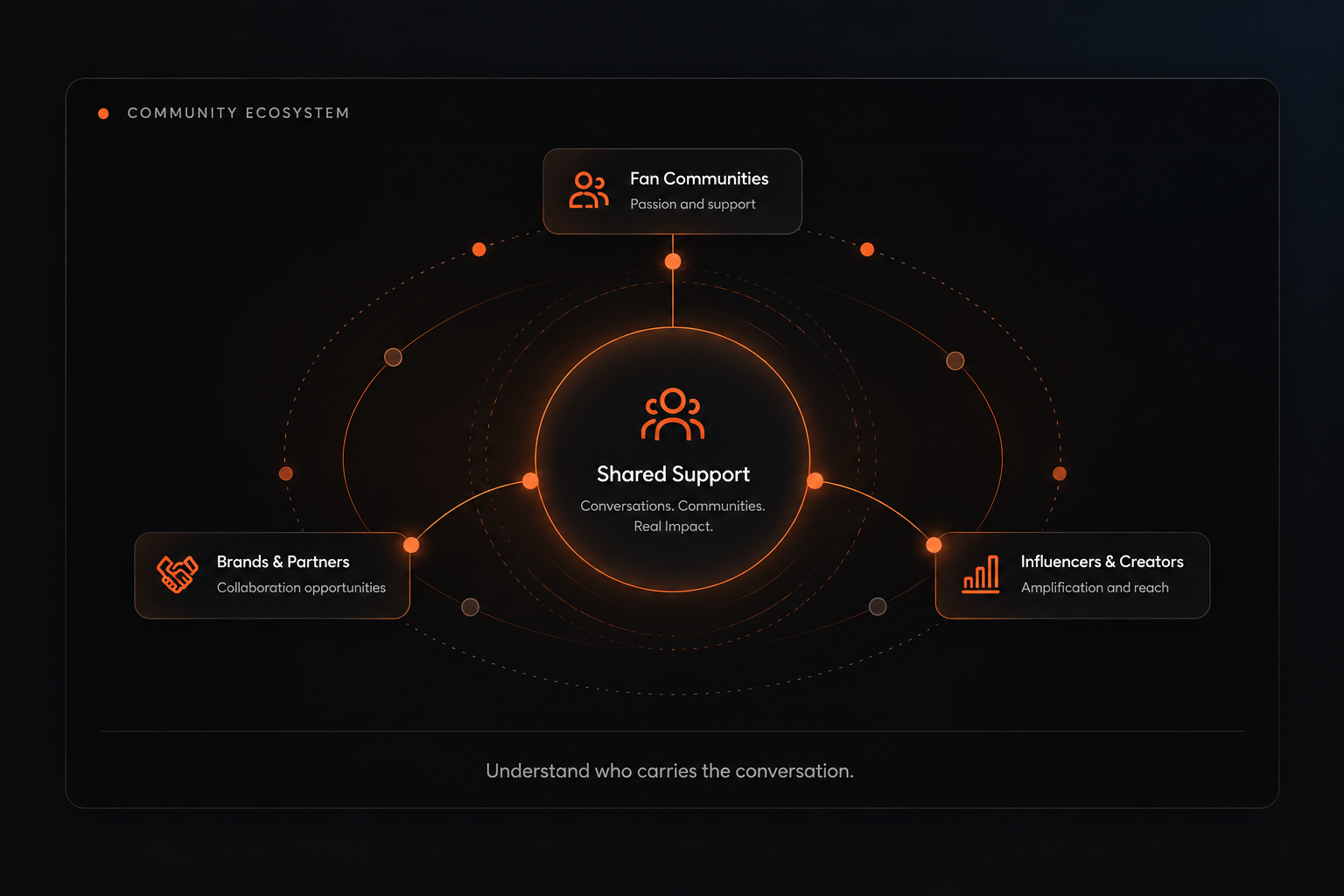
Fan communities & advocates
Understand where supportive conversation is sustained and which accounts are repeatedly amplified within those communities. This gives talent teams context about how support is expressed and shared.
Identify communities contributing sustained positive conversation around a public figure or their work.
Examine individual accounts whose posts are repeatedly amplified by others, alongside the conversation that earns that response.
Understand the relationship between an advocate and their community instead of interpreting follower totals as a complete picture of support.
Endorsement & reputation trends
Track sentiment relevant to a commercial association and examine the events behind changes. A contextual trend gives talent and commercial teams a better basis for review than a single period's overall reaction.
Focus the review on discussion connected to the commercial association, while keeping unrelated projects or controversies in their own context.
Examine the releases, appearances or other events associated with a sentiment change and the source material behind it.
Use the analysis to inform a partnership discussion. A sentiment trend supports judgement; it does not guarantee an endorsement's outcome.
In practice
Illustrative public-figure situations. These examples do not represent a named individual or a customer result.
Overall sentiment declines while a new project is receiving criticism.
Separate the project conversation from other work, public appearances and commercially relevant discussion before assessing the wider reputation.
Clarity about which context is changing.
Negative activity rises rapidly, with tightly repeated language and other accounts raising a specific concern.
Examine posting patterns and substantive criticism separately, then review the supporting posts with the PR team.
A more informed basis for deciding whether and how to respond.
For the team around the public figure
Talent, PR and commercial representatives approach the same reputation from different responsibilities. Context-specific sentiment, community insights and endorsement-related trends give each team relevant material to examine.
Understand the reception of a project or appearance in relation to the other conversations around the public figure.
Examine the concern being raised and the patterns behind a sudden change in attention.
Review the discussion relevant to a commercial association and the events behind its direction.
Access is scoped to assigned individuals or subjects. Review source coverage, permissions and retained history against the team's requirements.
Explore access and data handlingProjects, appearances and associations
Support and amplified conversation
Relevant movement and associated events
Celebrity questions
Anything not answered here, a product specialist can take in the demonstration.
Ask a questionIt is the public-reputation use of the Blura SAGA social media intelligence platform. It helps public figures, talent managers and PR teams examine sentiment by context, review coordination indicators, understand supportive communities and follow endorsement-related reputation trends.
A public figure can receive different reactions to a project, appearance and commercial association at the same time. Separating these discussions makes it possible to examine where a change is happening instead of treating the overall average as the whole reputation.
No. Findings come from the public sources and subjects configured for the deployment. The source list, language requirements and retained history must be reviewed for the team's needs. Coverage does not imply access to private conversations.
No. Account age, posting cadence, repeated phrasing and burst timing are indicators used to examine activity. They do not definitively establish who operates an account or whether it is automated. Human review and the underlying posts remain necessary.
An advocate is an account within a supportive community whose posts are repeatedly amplified by others in that community. The useful context is the relationship and conversation behind that support, rather than the follower count alone.
It follows sentiment relevant to a commercial association and the events connected with its changes. Confirm the available analysis period and retained history for your deployment. The findings inform commercial judgement and do not guarantee the outcome of a partnership.
No. The change may be concentrated in one project, appearance or source community. Review those contexts and the underlying material before interpreting a movement as a wider shift.
Access is bounded by role and the individuals or subjects assigned to a user. Detailed permissions, source coverage, hosting and retention requirements should be established for the team's deployment.
Your next step
Review the projects, public conversations and commercial associations your team needs to understand.