Identify local signals
Bring relevant public conversations and configured grievance inputs into view across locations and subjects that matter to your department.
Blura SAGA for Governance
Blura SAGA is a digital intelligence platform for government departments. Understand public conversations, identify emerging issues and examine the context behind them. Connect relevant findings to grievances, departments and designated officers for coordinated follow-up.

A clearer local picture
A state-wide average can hide a local concern. Blura SAGA connects public conversations and configured grievance inputs with issue and geographic context, helping government departments identify where attention is needed and examine the information behind a finding.
How public signals become structured intelligenceBring relevant public conversations and configured grievance inputs into view across locations and subjects that matter to your department.
Connect sentiment shifts with themes, locations and supporting source records to understand what is driving the conversation.
Track departmental responsibility and bring unresolved issues into the appropriate review and follow-up workflow.
Digital conversation reflects the sources being monitored. It is not a census of public opinion.
District & constituency intelligence
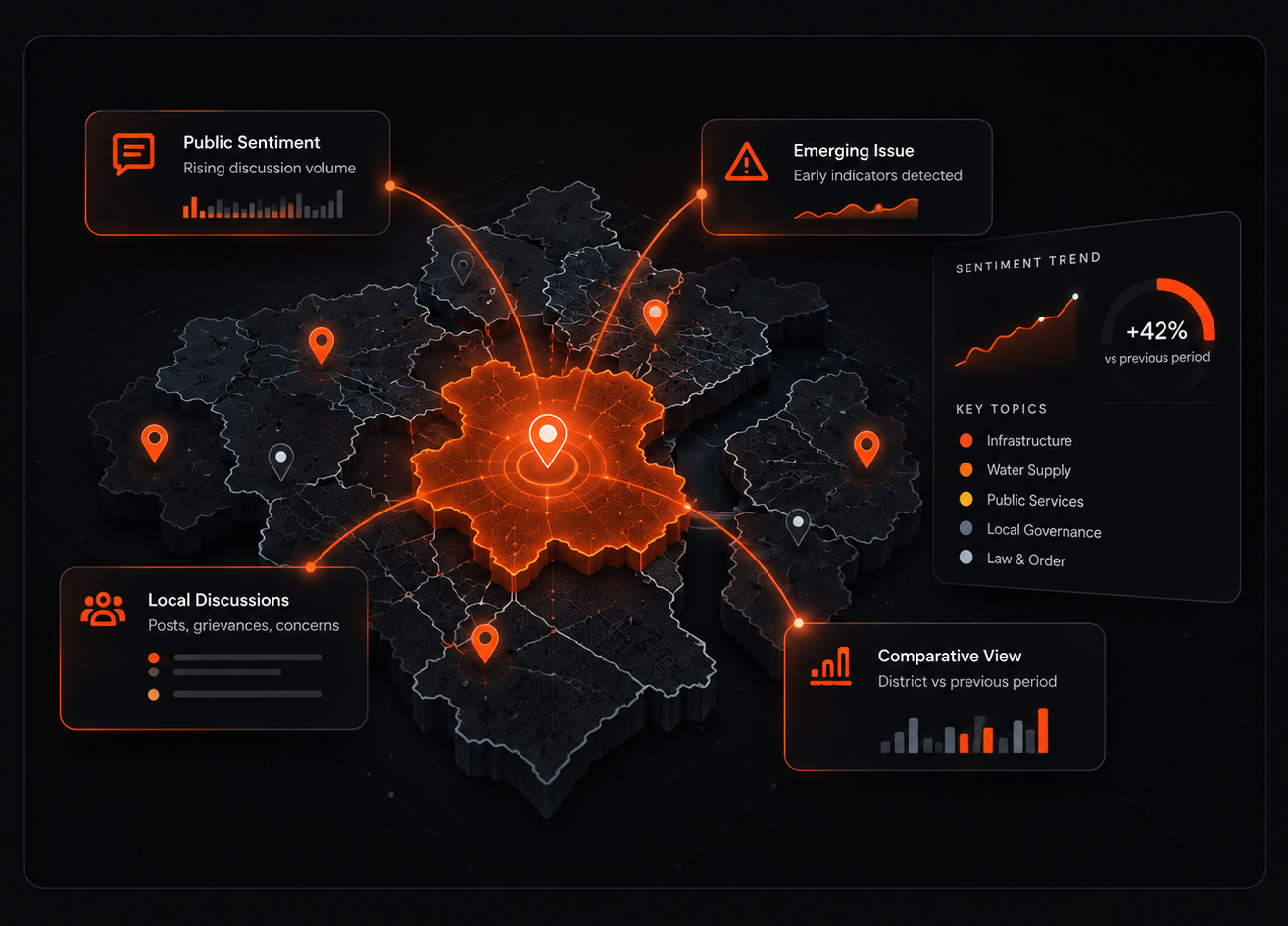
Examine public sentiment at district and local levels, with the issues driving the conversation alongside it. Compare areas and investigate emerging concerns without losing important local changes inside a broader average.
Review how public conversations are changing within the available geographic context. Open the posts, discussions and grievance inputs behind a reading to understand what is being discussed.
Examine how quickly an issue is developing within an area. Identify changes that may warrant closer review and connect them to the underlying conversation.
Compare areas alongside their previous periods to distinguish improving conditions from emerging or sustained concerns.
Geographic interpretation depends on the information available in the source. A precise location cannot be inferred for every post.
Policy, event & narrative analysis
Follow the response to an announcement, scheme or event by comparing the same areas before and after it. Examine the discussion behind a movement and how that discussion is being amplified.
Compare reactions around a policy change, budget or public event against each area's own preceding reading. Examine the eligibility questions, service concerns or other themes associated with the change.
Review account age, posting cadence, repeated phrasing and burst timing. Examine repeated amplification separately from the substantive concerns people are raising.
Return from the area or issue view to the underlying posts. The relationship between an event and a shift can be examined rather than assumed from a headline score.
Activity patterns support analyst review. They do not establish an account's identity or prove why a person posted.
A change is a finding to examine, not proof of its cause.
Grievance management
Turn recurring public complaints into issues with a responsible department and a visible status. Teams can examine where cases are waiting and which subjects are appearing repeatedly.
Subject · Area · Source
Owner · Status · Time in state
Action · Closed by · Record
Group complaints by subject and send them to the department responsible for that service or issue.
Follow New, In Progress and Resolved states, including the time spent in each state and the person who records closure.
Examine resolution reports by department and district. A backlog on one subject stays visible rather than disappearing into an overall total.
The platform records progress. The responsible department carries out the service response.
Intelligence briefings
A scheduled briefing brings together the areas that moved, the issues driving each change and grievances awaiting attention. Each finding retains a path to the public sources and records behind it.
See which districts or constituencies changed, with the issue behind each movement.
Review emerging narratives, sentiment shifts and activity that may require closer attention.
Open grievances, the department responsible and their recorded progress.
Areas to review and the issue behind each
Narratives and coordination indicators
Open grievances and responsible departments
In practice
Illustrative governance situations. Examples describe possible workflows rather than results from a customer deployment.
Overall discussion around a scheme appears favourable, while nearby districts raise the same eligibility question.
Compare district-level themes and inspect the underlying posts before deciding what clarification is needed.
The specific question and affected areas are visible.
Complaints about the same service remain in progress in one district.
Review the subject cluster, department ownership and recorded time in state, then bring the pattern into the briefing.
A follow-up grounded in departmental responsibility.
A policy discussion accelerates with repeated wording alongside individual accounts describing their experiences.
Examine coordination indicators and the substantive issue separately before interpreting the change.
A clearer view of the concerns beneath the activity.
Responsibilities & data handling
Government departments need to know which areas they can review and who owns the response. Access and operating boundaries are part of the deployment design.
Users see the geographies or subjects assigned to their role, supporting district and wider-area responsibilities.
Government administrations and political operations use separate deployments and data. Their responsibilities and access boundaries must remain distinct.
Review hosting, retention, source coverage, permissions and the audit trail against the operating department’s requirements.
Governance questions
Anything not answered here, a product specialist can take in the demonstration.
Ask a questionIt helps teams understand relevant public conversations, examine local sentiment and emerging issues, assess discussion around policies or events, and follow grievances through the responsible department. Findings can be brought into a briefing with their supporting source records.
No. It reflects the material available from the sources the deployment monitors. Differences in source coverage, language and who participates affect the picture. Teams should interpret digital sentiment alongside other administrative and public-feedback evidence.
Readings use the geographic context available to the deployment. An area view brings together relevant signals and the issues behind them, but a precise location is not available for every item. Review the sources behind a finding before drawing a geographic conclusion.
Issue velocity describes how quickly a subject is accelerating within an area. The driving issue and its source material accompany the reading. Review the score scale, band definitions and the deployment's geographic coverage during the demonstration.
The same areas can be compared before and after an announcement or event against their own preceding readings. The associated conversation helps explain the movement, but a change after an event does not by itself establish that the event caused it.
It is categorised by subject and routed to the department that owns it. New, In Progress and Resolved states record its progress, along with time in state and closure activity. Reports can be examined by department and district.
Areas that changed, the issues driving those changes, activity flagged for possible coordination and grievances still awaiting attention. The briefing is connected to the underlying records so a reader can examine the material behind a finding.
They use separate deployments and separate data. Within a deployment, users' access is scoped to their assigned geographies or subjects. Detailed permissions, hosting and retention requirements must be established for the operating body.
Your next step
Walk through the areas, issues, grievance responsibilities and briefing requirements your team works with.